
What You Should Know About Tempered, Laminated, and Insulated Glass
During the unrest in Paris on October 17, 2026, several luxury stores were damaged or looted. But one particular storefront attracted attention for a different reason, raising an interesting question about the different types of architectural glass used in modern buildings.
At a Louis Vuitton boutique on Place Vendôme, a group of attackers repeatedly struck the windows with a metal street barrier. The glass developed visible cracks, yet the attackers were unable to break through and enter the store.
The incident was reported by the Financial Times and published by CNA Luxury.
The incident highlights an interesting aspect of modern architectural glass: even when glass cracks, it does not always lose its ability to remain intact. Understanding the different types of architectural glass can help us see why glass behaves differently and how it is used in modern buildings.
Not All Glass Breaks the Same Way
Glass is used almost everywhere in modern buildings, from residential windows and balcony doors to commercial storefronts. Although these products may look similar, the glass inside them can be very different.
Some glass is designed to be stronger during everyday use. Some is designed to hold together after breaking. Other types focus on thermal insulation, sound reduction, or additional security.
Understanding these differences can help homeowners, developers, and building material buyers choose glass that better suits their projects.
Tempered, Laminated, and Insulated Glass: What’s the Difference?
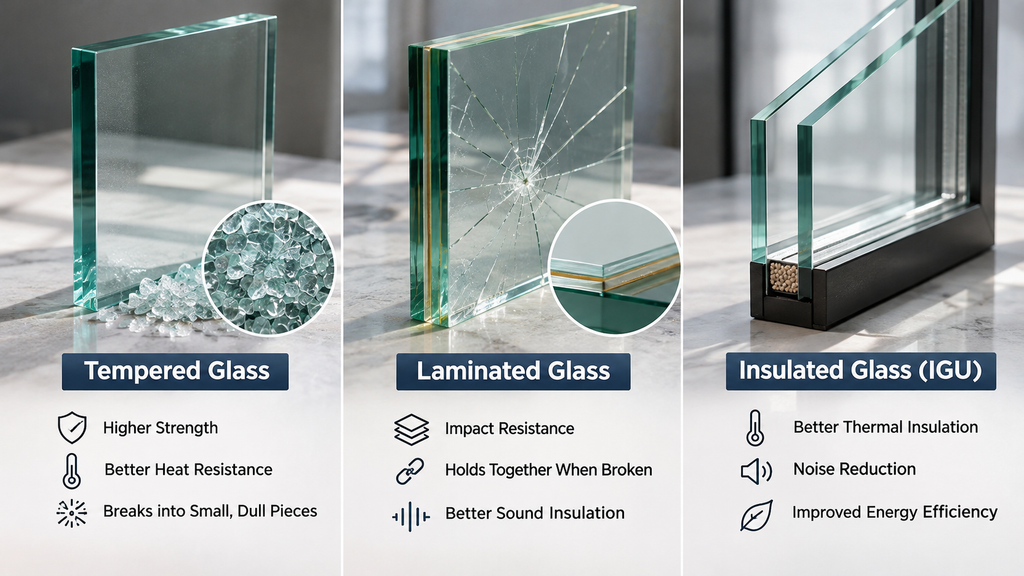
Three common terms appear frequently when discussing architectural glass.
Tempered Glass
Tempered glass is heat-treated to increase its strength compared with ordinary annealed glass.
It is widely used in windows, glass doors, partitions, and other building applications. When it breaks, it typically shatters into relatively small pieces rather than large, sharp shards.
Tempered glass is a common choice where strength and everyday safety are important.
Laminated Glass
Laminated glass consists of two or more glass panes bonded together with an interlayer, commonly PVB or another suitable material.
If the glass breaks, the interlayer helps hold the fragments together, reducing the risk of pieces falling away.
This makes laminated glass useful in applications where glass retention and safety are important, such as certain windows, doors, railings, and overhead glazing.
Some specialized laminated constructions can also provide additional security, but ordinary laminated glass should not be confused with tested security glazing.
Insulated Glass
Insulated glass, often called double glazing or triple glazing, consists of multiple glass panes separated by sealed cavities.
Its primary purpose is to improve thermal insulation. Depending on the configuration, it may also contribute to acoustic comfort.
An insulated glass unit can incorporate tempered glass, laminated glass, or both.
This is an important distinction: tempered and laminated describe how glass is processed or constructed, while insulated glazing describes how multiple panes are assembled into a sealed unit.
Strength, Safety, and Insulation Are Different Things
A window may be designed to meet several needs at once, but these performance characteristics should not be confused.
Strength refers to how glass responds to loads and impacts before breaking.
Safety often concerns what happens when glass breaks, including whether fragments remain attached or fall away.
Thermal insulation focuses on reducing heat transfer through the window.
Security relates to resistance against particular forms of impact or attempted intrusion.
A glass product may perform well in one area without necessarily providing the same level of performance in another.
For example, a double-glazed window may offer good insulation, but the number of panes alone does not indicate whether it is designed for security purposes.
Similarly, laminated glass can help retain broken fragments, but that does not automatically make it suitable for high-security applications.
Where Are Different Glass Types Commonly Used?
Different buildings and locations have different priorities.
| Application | Common Considerations |
|---|---|
| Residential windows | Thermal comfort, daylight, everyday safety |
| Balcony and patio doors | Safety, visibility, suitable glass strength |
| Large panoramic windows | Glass size, structural suitability, thermal performance |
| Commercial storefronts | Visibility, appearance, safety, and sometimes additional security |
| Overhead glazing | Appropriate safety glass and retention after breakage |
These are general examples rather than fixed specifications. The final glass selection depends on the window design, installation location, and applicable project requirements.
For many residential projects, a suitable insulated glass unit provides a practical combination of comfort and everyday performance.
Where additional safety or security is needed, other glass constructions may be considered.
Is Thicker Glass Always Better?
It is easy to assume that thicker glass must be stronger, safer, and more effective in every situation.
In practice, glass thickness is only one factor.
Glass type, processing method, interlayer construction, panel size, and supporting frame all influence performance.
Thicker glass also increases weight, which can affect window hardware, frame design, and installation.
For example, a large opening window may require different considerations from a fixed panoramic window, even if both use similar glass.
Rather than simply choosing the thickest available option, it is more practical to select a glass configuration suited to the window’s size, function, and intended use.
Choosing the Right Glass for Your Windows and Doors
For most building projects, the best glass is not necessarily the most expensive or technically complex option.
A residential window in a cold climate may prioritize thermal insulation, while a commercial entrance may place greater emphasis on everyday safety and durability.
A large scenic window may require a different combination of glass thickness, strength, and thermal performance.
Budget also matters. More complex glazing configurations can increase material costs and may require compatible frames or hardware.
The goal is to find a practical balance between performance, appearance, and cost.
At CEALUM, we offer aluminum and uPVC window solutions for residential and commercial projects, with glazing configurations discussed according to product specifications and individual requirements.
Explore our Aluminum Windows and uPVC Windows ranges to learn more about available options.
Frequently Asked Questions
Is laminated glass unbreakable?
No. Laminated glass can crack or break. Its interlayer helps hold fragments together, but the level of impact resistance depends on the specific construction.
Is tempered glass stronger than regular glass?
Tempered glass generally has higher mechanical and thermal strength than ordinary annealed glass of comparable thickness. However, its suitability depends on the intended application.
Can double-glazed windows use laminated glass?
Yes. Insulated glass units can incorporate laminated or tempered panes, depending on the required configuration and compatible window system.
Does thicker glass provide better sound insulation?
Not necessarily. Acoustic performance depends on the complete glazing construction, including glass thickness combinations, interlayers, cavity dimensions, and other factors.
Final Thoughts
Modern architectural glass is much more versatile than it may first appear.
From tempered glass used in everyday building applications to laminated glass that helps retain fragments after breakage, different glass constructions serve different purposes.
Understanding these basic differences can help buyers make more informed decisions without assuming that one type of glass is always better than another.
For residential and commercial projects, the right glazing choice begins with understanding how and where the window or door will be used.