
Building Material Sourcing from China can be a practical option for construction projects that need competitive manufacturing, customization, or a wide range of product choices.
But for a first-time buyer, the process can quickly become complicated.
Where should you start? What information should you prepare? How do you compare quotations from different suppliers? And if several factories are involved, how do you make sure everything arrives correctly and on time?
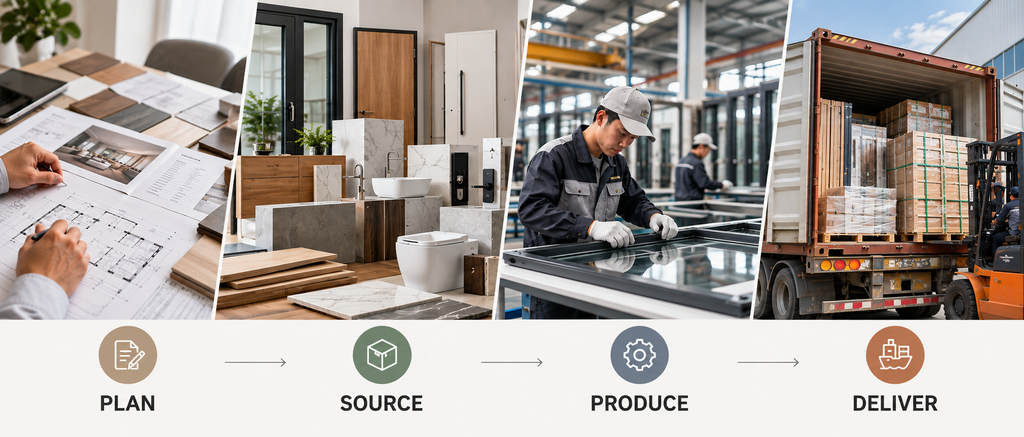
Whether you are sourcing one product category, such as doors or windows, or materials for an entire villa, apartment or hotel project, the process can generally be divided into three stages:
Prepare → Compare & Confirm → Produce & Deliver
Getting these three stages right is usually more important than simply finding the lowest factory price.
Stage 1: Prepare Before You Start Sourcing
Start with the project requirements
Before contacting suppliers, first define what you actually need.
For a single product category, the information can be relatively simple. If you are sourcing aluminum windows, for example, useful information may include:
- Window dimensions and quantities
- Opening types
- Glass requirements
- Frame color and finish
- Hardware requirements
- Project location
- Any required performance standards
For a larger project involving multiple material categories, it helps to prepare more complete project information, such as:
- Architectural drawings
- Floor plans
- BOQ (Bill of Quantities)
- Material schedules
- Door and window schedules
- Interior design drawings
- Reference images
- Target quality level or budget
- Project location and destination
You do not need to have everything ready before making the first inquiry.
However, the more clearly the project requirements are defined, the more meaningful the quotation will be.
A reference image, for example, can communicate the appearance you want, but it usually cannot define the exact material, construction, dimensions or performance requirements.
For customized building materials, drawings and specifications become increasingly important as the project moves toward production.
What makes sense to source from China?
China has a broad manufacturing base for construction and interior products.
Common categories for overseas projects include:
- Doors and windows
- Kitchen cabinets and wardrobes
- Flooring
- Sanitary ware
- Lighting
- Architectural hardware
- Furniture
- Aluminum products
- Decorative wall and ceiling materials
- Stone and surface materials
- Prefabricated and modular building components
China can be particularly competitive when products require custom dimensions, coordinated finishes, project quantities or combined procurement across several categories.
For some highly localized or regulation-sensitive products, local availability and compliance requirements should also be considered during the planning stage.
The goal is not simply to import as many products as possible. It is to identify which categories make practical and economic sense for the project.
Stage 2: Compare and Confirm
Compare specifications first. Compare prices second.
This is one of the most important principles in building material sourcing from China.
Two suppliers may quote what appears to be the same product while actually offering very different specifications.
Take an aluminum window as a simple example.
The price may change depending on:
- Aluminum profile system
- Profile thickness
- Glass configuration
- Low-E coating
- Hardware
- Surface finish
- Thermal performance
- Accessories
The same applies to doors, cabinets, flooring, sanitary ware and many other building products.
Therefore, a lower quotation does not necessarily mean the same product is available at a lower price.
Before comparing prices, check whether the specifications and supply scope are actually comparable.
A useful quotation should make it reasonably clear what is included, what specification is being offered and what is not included.
Select the right quality level for the project
Not every project needs the same level of product.
A rental apartment, private villa, luxury hotel and commercial development may require very different specifications even when purchasing the same product category.
Instead of simply dividing suppliers into “cheap” and “expensive,” consider:
- Material and construction
- Finish quality
- Hardware and components
- Manufacturing consistency
- Customization capability
- Packaging
- Required test reports or certifications
- Suitability for the intended application
The objective is to match the product to the project.
This also makes budget control easier. More of the budget can be allocated to products where performance and durability matter most, while other areas can be optimized without unnecessarily increasing the overall project cost.
Confirm before production
Once a suitable supplier and specification have been identified, technical confirmation becomes important.
Depending on the product, this may involve:
Sample / Finish → Drawing → Specification → Production
For example, a flooring order may require an approved color sample.
A custom door may require confirmation of dimensions, finish, hardware and shop drawings.
A window order may require confirmation of profile, glass, opening method, hardware and performance requirements.
For projects involving several product categories, keeping these approvals organized becomes even more important.
Once customized production has started, some changes may become costly, delay production or no longer be possible.
It is therefore usually better to resolve uncertainties before production rather than during it.
Stage 3: Produce and Deliver
Quality control should follow the approved specification
“Quality inspection” is only useful when there is something specific to inspect against.
Depending on the product, pre-shipment checks may include:
- Dimensions
- Materials
- Color and finish
- Hardware
- Function
- Quantity
- Accessories
- Packaging
These should be compared with the approved drawings, samples, specifications or order documents.
For products subject to local building regulations, compliance requirements should be identified before production. A pre-shipment inspection can check whether the manufactured product matches the approved order, but it does not replace required local certification or regulatory approval.
When several suppliers are involved
Sourcing one product from one factory is relatively straightforward.
A project involving doors, windows, cabinets, flooring, sanitary ware, lighting and furniture is different.
Each supplier may have a different production schedule, packaging method and delivery date.
There may also be coordination between products.
Cabinet dimensions can depend on appliances and finished wall conditions. Door dimensions can relate to finished floor levels. Basin selection can affect countertop openings. Colors and finishes from different factories may need to work together within the same interior design.
For multi-category projects, Building Material Sourcing from China often involves coordinating several manufacturers, so supplier coordination can become as important as product sourcing itself.
Products from different factories can often be delivered to a consolidation point and shipped together when their schedules, packaging and loading requirements allow.
This can simplify international shipping and improve container utilization, especially for larger project orders.
Factory Price ≠ Landed Cost
When planning Building Material Sourcing from China, one of the easiest mistakes for a first-time importer is comparing only the factory price.
An EXW quotation, for example, does not represent the total cost of getting the product to your project.
Depending on the shipment and trade terms, additional costs may include:
Factory price
- export packaging
- transportation within China
- consolidation or export handling
- international freight
- destination charges
- duties and taxes
- local delivery
= Landed Cost
For this reason, a product with the lowest EXW price does not always result in the lowest final procurement cost.
Packaging dimensions, order quantity and container utilization can have a significant effect, particularly for bulky construction materials.
The more useful comparison is therefore between products with similar specifications and their realistic delivered cost, rather than factory prices alone.
A Simple Building Material Sourcing Checklist
A simple checklist can make Building Material Sourcing from China easier to manage, especially for first-time buyers.Before requesting quotations:
☐ Drawings or dimensions
☐ Quantities
☐ Required materials or specifications
☐ Reference images
☐ Target quality level
☐ Project location
☐ Relevant local standards
☐ Expected delivery schedule
Before production:
☐ Final dimensions and drawings
☐ Approved materials and finishes
☐ Hardware and accessories
☐ Technical specifications
☐ Packaging requirements
☐ Final quantities
Before shipment:
☐ Product inspection
☐ Quantity check
☐ Packaging check
☐ Packing list
☐ Consolidation or container loading plan
☐ Shipping documents
A clear sourcing process does not eliminate every possible issue, but it can prevent many of the specification, quantity, finish and delivery problems that are much more difficult to solve after shipment.
Frequently Asked Questions
What documents do I need before requesting a quotation?
For a single product category, dimensions, quantities, specifications and reference images may be enough for an initial quotation.
For a larger construction project, architectural drawings, BOQ, material schedules and product specifications can help suppliers understand the scope more accurately.
Not every document needs to be complete before the first discussion.
Can I source only one type of building material from China?
Yes. Many buyers source individual categories such as doors, windows, cabinets, flooring, sanitary ware or furniture from China.
The sourcing process can be adapted to either a single product category or a multi-category construction project.
Can products from different factories be shipped together?
Yes, in many cases.
Products from different manufacturers can be consolidated when production schedules, packaging, dimensions, weight and handling requirements are compatible.
For larger projects, planning consolidation before production is usually more effective than trying to combine shipments at the last minute.
Is sourcing building materials from China cheaper?
China can offer strong cost advantages for many building material categories, particularly for project quantities and customized products.
However, the comparison should be based on equivalent specifications and include packaging, international logistics and other relevant costs.
Comparing the total landed cost usually provides a more realistic picture than comparing factory prices alone.
Planning a Construction Project?
If you already have drawings, a BOQ or material list, CEALUM can help review the project scope and identify suitable product categories for sourcing from China before detailed product selection and quotations begin.
CEALUM
Design · Manufacturing · Integrated Building Supply