
When planning a villa, one of the first sourcing decisions is not simply where to buy materials, but which materials are actually worth sourcing internationally.
Villa Building Materials from China can range from windows, doors and cabinetry to sanitary ware, stone, lighting and furniture. China offers a very broad manufacturing base, but that does not mean every item in a villa should be imported.
For some products, customization, design flexibility and product variety can make sourcing from China particularly worthwhile. For others, local availability, shipping efficiency, regulations or future maintenance may make local purchasing more practical.
The right choice depends on the villa itself: its design, location, intended use and expected quality level.
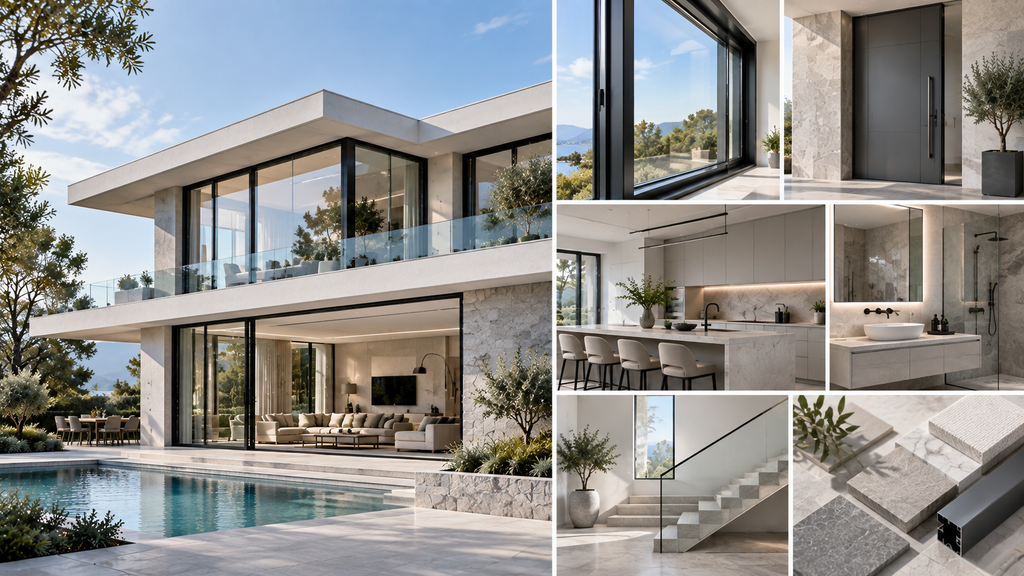
Why Villa Material Selection Is Different
A villa is not simply a smaller version of a commercial construction project.
Quantities may be lower, but individual material choices are often much more visible in the finished home.
The entrance door becomes part of the architectural character. Window proportions affect the façade, natural light and views. Kitchen cabinets influence both appearance and daily use. Stone, wood finishes, hardware and lighting can change the feeling of an entire room.
At the same time, a villa combines very different types of products.
Some elements are closely tied to architectural dimensions and benefit from customization. Others are relatively standardized and can be selected from existing product ranges. Some basic construction materials have little reason to travel thousands of kilometres at all.
That is why the question should not be:
“How many villa materials can I buy from China?”
A more useful question is:
“Which products gain enough value from Chinese manufacturing, customization or product choice to make international sourcing worthwhile?”
Villa Materials with High Sourcing Value
Among Villa Building Materials from China, the strongest sourcing candidates are usually products where dimensions, finishes, configuration or design matter significantly.
Windows and Exterior Doors
Windows and exterior doors are closely connected to the architecture.
Dimensions, frame profiles, opening methods, glass configurations, colours and hardware can all be selected according to the villa design rather than limited to standard retail sizes.
For villas with large openings, distinctive façades or specific performance requirements, this flexibility can be particularly valuable.
However, the required thermal, wind, water and other performance specifications should always be determined according to the project location.
Entrance and Interior Doors
Doors occupy a surprisingly large part of the visual language of a villa.
Height, proportion, veneer direction, paint colour, handles and surrounding wall finishes can all affect the result.
A standard door may be perfectly suitable for a simple room. But where the entrance or interior design calls for oversized doors, concealed frames, particular veneers or coordinated finishes, customization becomes much more meaningful.
Kitchen Cabinets, Wardrobes and Bathroom Vanities
Built-in cabinetry is one of the clearest examples of where project-specific manufacturing can add value.
Cabinets need to respond to actual room dimensions, ceiling heights, appliances, storage habits and interior finishes.
The benefit is therefore not merely choosing a different colour. Properly planned cabinetry can use space more efficiently while helping kitchens, bedrooms and bathrooms follow the same design direction.
Staircases, Railings and Decorative Metalwork
These elements often sit somewhere between construction and interior design.
Dimensions must fit the building, while materials, profiles and finishes need to work with the surrounding space.
Where the staircase or railing is visually prominent, project-specific fabrication can offer more value than selecting a generic finished product.
Decorative Wall and Wood Finishes
Wood veneer, wall panels, decorative metal and other feature finishes can also be suitable when they play an important role in the interior.
Their value is highest when they are selected as part of a broader material palette rather than as isolated decorative products.
Materials That Depend on the Project
A second group cannot be classified as simply “worth importing” or “better locally.”
Their suitability depends heavily on the design, quantity and location of the villa.
Sanitary Ware and Faucets
China offers an enormous range of basins, toilets, bathtubs, showers and faucets.
For a villa requiring several bathrooms with a consistent design direction, sourcing these products together may offer useful choice.
But local standards, plumbing compatibility, spare parts and after-sales service should also be considered.
Lighting
Decorative lighting can have strong sourcing value when the interior requires distinctive fixtures or coordinated styles.
Technical lighting is different. Electrical standards, drivers, controls, certifications and future replacement requirements may matter more than appearance alone.
The two should not automatically be treated as the same purchasing decision.
Furniture
Furniture can make sense when it forms part of a complete interior concept, especially when several rooms require coordinated pieces, dimensions or finishes.
For a small number of ordinary loose items, local purchasing may be simpler.
Tiles and Stone
Tiles and stone deserve case-by-case consideration.
Special formats, finishes, patterns or coordinated stone applications may justify international sourcing. Common local materials may not.
Weight alone does not decide the answer. The question is whether the particular material provides enough design or specification value to justify transporting it.
Different Villas Need Different Material Priorities
There is no universal “best” material package for every villa.
How the property will be used changes what matters.
Private Owner-Occupied Villa
For a private home, daily experience usually matters more than product repetition.
Storage habits, kitchen use, privacy, natural light, preferred textures and maintenance expectations can all influence material choices.
Customization often has greater value here because the house is being designed around a particular household rather than an average user.
Holiday or Rental Villa
Rental villas usually place greater emphasis on durability, easy cleaning, maintenance and replacement.
A delicate finish may look impressive on completion but become inconvenient after repeated guest use.
In these projects, practical performance may deserve more weight than highly individualized detailing.
High-End Custom Villa
For a high-end custom home, individual products are rarely judged in isolation.
Door proportions, veneer grain, stone selection, metal finishes, lighting and transitions between materials become part of one visual composition.
Here, the value of customization lies less in making every product unusual and more in making different products belong together.
Multi-Villa Development
For several villas, repeatability and consistency become more important.
A development can still have a distinctive design, but repeated dimensions, product families and finishes can help maintain a consistent result across different units.
The material strategy therefore shifts from maximum individualization toward a balance between design character and repeatable specifications.
Think in Spaces, Not Only in Product Categories
A purchasing list might separate cabinets, stone, faucets, lighting and hardware into different categories.
A homeowner never experiences them that way.
They experience a kitchen, a bathroom or an entrance.
Kitchen
A kitchen brings together cabinetry, worktops, backsplash materials, sinks, faucets, handles, appliances and lighting.
A warm wood cabinet that looks attractive by itself may feel completely different beside a cool grey stone worktop. A metal handle may technically match the specification but still conflict visually with the faucet or nearby lighting.
Looking at these materials together helps answer a more useful question:
Do they create the kitchen the design is trying to achieve?
Bathroom
Bathrooms concentrate many materials into a relatively small area.
Vanity finishes, basins, faucets, mirrors, shower frames, hardware, lighting and tiles all interact visually.
At the same time, water exposure, cleaning, slip resistance and daily maintenance matter just as much as appearance.
Entrance and Main Living Area
The entrance door, flooring, wall finishes, lighting, staircase and nearby metal details may all be visible at once.
Selecting each product independently can produce small colour and finish differences that become surprisingly obvious after installation.
For this reason, reviewing villa materials by space can reveal problems that separate product catalogues cannot.
Where Is Customization Actually Worth Paying For?
The fact that a product can be customized does not mean it should be.
Customization has the greatest value when it solves a dimensional, functional or visual requirement.
It makes sense for a window that needs a particular proportion, a built-in wardrobe that must fit an irregular wall, an entrance door that forms an important part of the façade, or a wall finish that needs to align with other interior elements.
By contrast, a standard basin, chair, lamp or accessory may already perform perfectly well and suit the design.
For villa projects, a useful principle is:
Customize where the difference will be seen, used or felt. Standardize where it will not.
That usually produces a better result than turning customization itself into the objective.
Keep the Villa Looking Like One Home
Finish consistency is easy to underestimate when products are selected separately.
Take walnut as a simple example.
A walnut door, walnut wardrobe and walnut wall panel can all be described with the same word while looking noticeably different when installed together.
One may have a reddish tone. Another may be grey-brown. Grain direction, texture and gloss level may also vary.
Metal finishes create the same problem.
“Brushed gold,” “champagne,” “bronze” and even “black” are not universal colours. Handles, faucets, shower frames and lighting fixtures carrying the same finish name can still look different side by side.
Lighting then changes the perception again. The same wood or stone can appear warmer or cooler under different colour temperatures.
For a villa, material coordination therefore means more than matching product names.
The materials that will appear together should be evaluated together.
Choose Materials for the Way the Villa Will Be Used
Location and lifestyle can change what constitutes a good material choice.
For a coastal villa, corrosion resistance deserves greater attention, particularly for exposed metal components and hardware.
In a home with young children, safety glazing, durable finishes, easy-clean surfaces and certain edge details may become more important.
For older occupants, bathroom slip resistance, thresholds, handle operation and lighting can have a meaningful effect on daily comfort.
A holiday home that remains empty for long periods may benefit from materials and systems that require less maintenance and are easier to service.
A villa designed mainly for entertaining may place greater importance on large openings, kitchen capacity, indoor-outdoor connections and heavily used communal spaces.
A material specification can look excellent on paper and still be poorly suited to the people who actually live with it. Houses have the irritating habit of eventually being used by humans.
From Villa Design to the Right Material Scope
A practical material scope can usually begin with a few pieces of project information:
- architectural floor plans;
- elevations and key dimensions;
- interior drawings or design references;
- project location and climate;
- intended use of the property;
- expected quality and design level.
These provide enough context to begin separating the villa materials into three groups:
Worth sourcing from China
Products where customization, design choice or manufacturing capability creates meaningful value.
Project-dependent
Products that should be judged according to specification, quantity, local availability and the villa design.
Better sourced locally
Products where transport, regulations, construction practices, service or local availability outweigh the benefits of importing.
The objective of selecting Villa Building Materials from China is not to maximize the number of imported products, but to identify the combination that makes the most sense for the villa.
For villa owners, developers and contractors who already have architectural drawings, elevations or interior references, CEALUM can review the project and help identify suitable Villa Building Materials from China, with the material scope developed around the design, location and intended use of the property.
For the broader sourcing process, see our guide to Building Material Sourcing from China for construction projects.
CEALUM
Design · Manufacturing · Integrated Building Supply
Frequently Asked Questions
Which villa building materials are most worth buying from China?
Products that benefit from customized dimensions, finishes or design coordination often offer the strongest sourcing value. Typical examples include windows, entrance and interior doors, kitchen cabinets, wardrobes, bathroom vanities, staircases, railings and selected decorative finishes.
Should I buy all villa materials from China?
No. Basic heavy construction materials are usually more practical to purchase locally, while some regulation-sensitive or service-dependent products may also be better sourced near the project. The appropriate scope depends on the villa rather than on how many products are available from China.
Can materials be customized to match my villa design?
Many villa products can be customized in dimensions, materials, colours, finishes and configurations. Customization is most useful for products that are fitted to the building or have a strong influence on the architectural or interior design.
Is sourcing from China suitable for a single private villa?
Yes, depending on the material scope. A single villa can benefit from customized products, broader design choices and coordinated finishes. Larger developments have different advantages, particularly repeatability and consistency, but project size alone does not determine whether sourcing from China is suitable.