
When choosing windows for a building project, many buyers compare aluminum vs uPVC windows to understand which option better fits their needs.
Both are widely used for homes, apartments, hotels and commercial buildings, but they have different strengths.
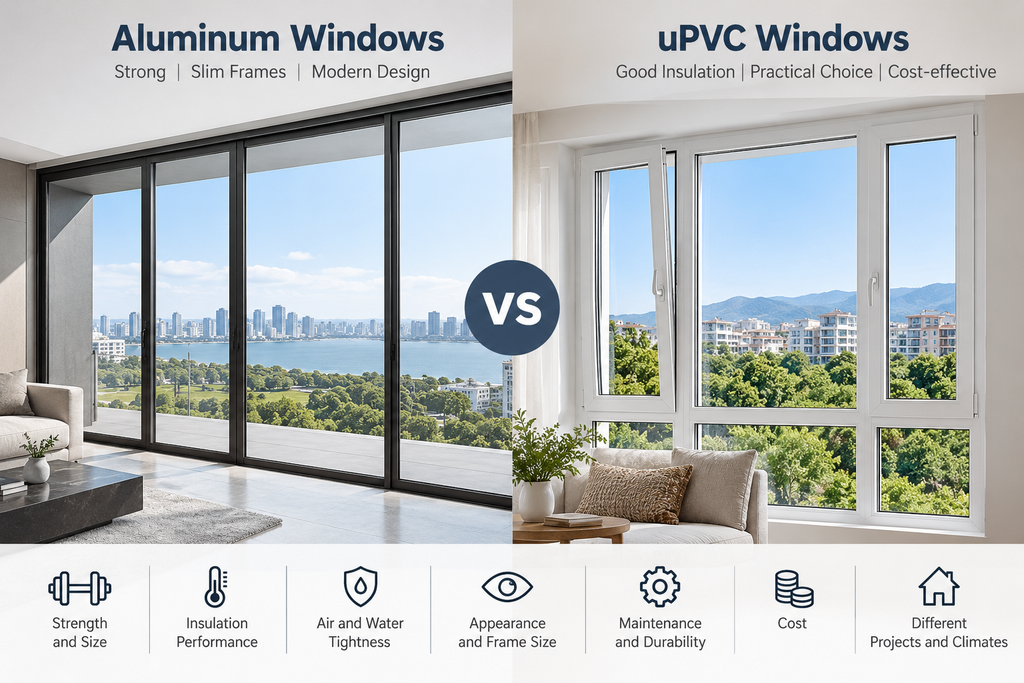
Aluminum windows are stronger and are often chosen for larger windows, slim frames and modern designs. uPVC windows have an advantage in frame insulation and are widely used for standard residential windows, especially when insulation and budget are important.
So instead of asking which one is simply better, the more useful question is:
Which one is better for your project?
The answer usually depends on the window size, climate, building design, performance requirements and budget.
1. Large Windows and Frame Strength
One of the clearest differences between aluminum and uPVC is strength.
Aluminum is strong and rigid, so the frames can remain relatively slim while supporting larger glass panels. This makes it especially suitable for floor-to-ceiling windows, large sliding doors and other large glass openings.
uPVC is widely used for standard residential window sizes. Larger uPVC windows are also possible, but the profile system and internal reinforcement need to be selected according to the window size.
The practical difference is simple: aluminum is generally better suited to large windows, wide sliding doors and slim-frame designs.
2. Which Has Better Insulation?
If thermal insulation is a priority, uPVC has a natural advantage because the frame material itself transfers less heat.
Aluminum can also provide good insulation. For projects with higher insulation requirements, thermal break aluminum windows are commonly used.
However, the frame is only one part of the window. Glass also has a major influence on overall performance. Depending on the project, double or triple glazing, Low-E glass and argon gas can be used.
So it is better to compare the complete window system rather than the frame material alone.
In simple terms, uPVC has an advantage in frame insulation, while thermal break aluminum offers a good combination of insulation, strength and slim-frame design.
3. What About Air and Water Tightness?
There is no simple winner for air and water tightness.
These two points depend more on the window design, opening style, seals, drainage and hardware than on whether the frame is aluminum or uPVC.
For example, casement and sliding windows use different sealing systems, so even windows made from the same material can have different performance.
If wind and rain performance is important for your project, compare the actual window systems rather than the frame material alone.
4. Appearance and Frame Size
Appearance is another clear difference.
Because aluminum is stronger, the frames can usually be made slimmer. This allows larger glass areas and gives the window a cleaner, more modern appearance.
Aluminum also offers a wide range of colors and finishes, including powder coating and wood-look finishes.
uPVC frames are usually wider. White is very common, while other colors and wood-look finishes are also available.
For standard residential windows, the difference in frame width may not be important. But if the project focuses on large glass areas, slim frames and a modern appearance, aluminum has a clear advantage.
5. Maintenance and Durability
Both aluminum and uPVC windows are low-maintenance. They normally do not require regular painting, and everyday cleaning is simple.
Aluminum is strong and stable, which makes it well suited to larger windows and doors. uPVC is also durable for normal residential use and is widely used for houses and apartments.
For most projects, maintenance is not the main reason to choose one over the other. The quality of the profiles, hardware, seals and production is more important.
For coastal projects, suitable finishes and hardware should also be selected according to the local environment.
6. Which Costs More: Aluminum vs uPVC Windows?
For comparable standard window configurations, uPVC is usually more economical, while thermal break aluminum is generally more expensive.
The difference can become more noticeable when aluminum windows use slim-frame systems, larger glass panels, special finishes or large sliding designs.
However, both materials are available in different specifications. Price should therefore be compared based on similar window sizes, glass and performance requirements.
For example, uPVC may be a practical choice for standard bedroom windows, while aluminum may be more suitable for a large living-room window or sliding door.
For some projects, using different window systems in different areas can be a practical way to balance design, performance and budget.
7. Aluminum or uPVC Windows for Different Climates?
Climate is important, but it should be considered together with the complete window system.
Cold Climates
uPVC is widely used in cold climates because of its good frame insulation.
Thermal break aluminum is also suitable, especially when larger windows, slimmer frames or a particular architectural design are required.
In both cases, the glass configuration is also important for overall insulation.
Hot and Sunny Climates
Both aluminum and uPVC windows are widely used in warm climates.
In these areas, glass selection is especially important. Depending on the project, Low-E or solar control glass can help reduce heat entering through the windows.
The choice between aluminum and uPVC can then be based on window size, design and budget.
Coastal Areas
Both materials can be used for coastal projects.
For aluminum windows, suitable finishes and hardware should be selected for the project location. For uPVC windows, suitable hardware is also important.
Climate can help narrow down the options, but it does not decide the frame material by itself.
8. Which Is Better for Different Projects?
The type of building can also make the choice easier.
Houses and Apartments
For standard residential windows, uPVC is often a practical choice when insulation and budget are important.
Aluminum is often preferred for larger windows, wide sliding doors, slim frames and modern designs.
For villas, both can be used. The choice should depend on the actual window sizes and design rather than the building type alone.
Hotels and Resorts
Hotels often have different requirements in different areas.
Guest rooms may use standard-sized windows, while lobbies, restaurants and public areas may have much larger glass openings.
For this reason, different window systems can be used in different areas when it gives a better balance of design, performance and budget.
Commercial Buildings
Aluminum is commonly used for commercial buildings because its strength works well with larger windows, large glass areas and modern designs.
For offices and other areas with standard window sizes, both aluminum and uPVC can be considered depending on insulation, appearance and budget.
9. Aluminum vs uPVC Windows: A Simple Comparison
The main differences can be summarized simply:
| Project Requirement | Aluminum Windows | uPVC Windows |
|---|---|---|
| Large windows | Better suited | Suitable, depending on the system |
| Slim frames | Clear advantage | Usually wider |
| Frame insulation | Good with thermal break systems | Natural advantage |
| Standard residential windows | Very suitable | Very suitable and often economical |
| Large sliding doors | Clear advantage | More dependent on the system |
| Color and finish options | Wider range | Good range |
| Maintenance | Low | Low |
| Modern building design | Clear advantage | Common for standard residential designs |
| Initial budget | Usually higher for thermal break systems | Usually more economical |
This does not mean one material is better in every situation. It simply shows where the main differences are.
So, Which One Should You Choose?
There is no absolute winner in the Aluminum vs uPVC Windows comparison, but the main differences are clear.
Aluminum is stronger and better suited to large windows, slim frames, wide sliding doors and modern building designs.
uPVC has an advantage in frame insulation and is often more economical for standard residential windows.
If the project has large openings or places more importance on slim frames and modern design, aluminum is usually the more suitable option.
If the project mainly uses standard residential windows and insulation and budget are the priorities, uPVC is often the more practical choice.
If both design and insulation are important, compare the actual aluminum and uPVC window systems available for the project rather than choosing by material name alone.
For some projects, using different systems in different areas can also make sense.
If you are planning to source windows for an international project, you can also read our guide on how to import doors and windows from China.
For project sourcing, you do not need to decide between aluminum and uPVC before discussing the details. CEALUM can recommend and compare suitable window options based on the window sizes, local climate, design requirements and budget, so you can understand the practical differences before making a final choice.
The goal is not to decide which material wins. It is to choose the window system that works best for the building and the project budget.
FAQ
Are uPVC windows better for cold climates?
uPVC windows have an advantage in frame insulation and are widely used in cold climates.
Thermal break aluminum windows can also provide good insulation, especially when larger windows or slimmer frames are required. The frame and glass should be considered together.
Are aluminum windows more durable?
Aluminum windows are strong and stable, making them particularly suitable for larger windows and sliding doors.
uPVC windows are also durable for normal residential use. For both materials, the quality of the profiles, hardware, seals and production affects the overall quality and service life.
Which costs more, aluminum or uPVC windows?
For comparable standard configurations, uPVC windows are usually more economical than thermal break aluminum windows.
The final price still depends on the window size, glass, opening style, hardware, finish and performance requirements.