
When buying building materials from China, understanding EXW vs FOB vs CIF vs DDP can help you compare quotations and identify who handles shipping, customs clearance and delivery.
The difference is not simply the shipping cost. These terms help you understand how far the supplier handles the shipment and which parts of the transportation are handled by the buyer.
For example, EXW is essentially a factory-level price. FOB extends the supplier’s scope to the agreed Chinese port and loading on board the nominated vessel. CIF goes further by including ocean freight and the required insurance to the agreed destination port. DDP covers transportation to the agreed destination, including import clearance and applicable duties and taxes, with the goods delivered ready for unloading by the buyer.
Understanding these differences makes it easier to compare quotations, especially when transportation and handling represent a significant part of the total purchase cost.
EXW vs FOB vs CIF vs DDP: Quick Comparison
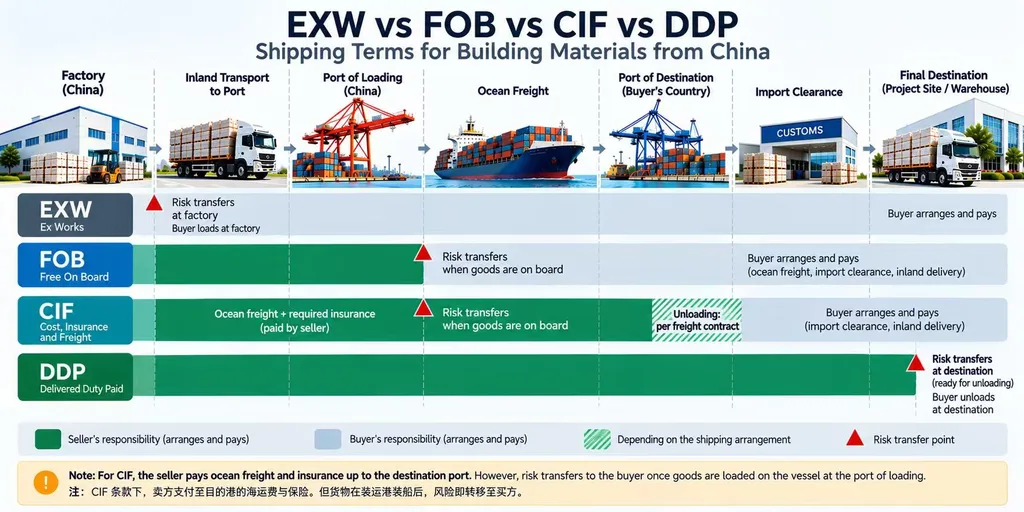
A simple way to understand these four terms is to look at how far the supplier handles the shipment.
| Trade Term | Supplier’s Scope | Export Clearance | Main International Freight | Import Clearance | Loading / Unloading |
|---|---|---|---|---|---|
| EXW | Goods ready for collection at the factory or warehouse | Buyer | Buyer | Buyer | Buyer loads at pickup |
| FOB | Goods delivered on board the nominated vessel at the agreed Chinese port | Seller | Buyer | Buyer | Seller delivers goods on board |
| CIF | Freight and required insurance arranged to the agreed destination port | Seller | Seller | Buyer | Seller delivers goods on board; destination unloading costs depend on the shipping arrangement |
| DDP | Goods delivered to the agreed destination, ready for unloading | Seller | Seller | Seller | Buyer unloads at destination |
The quotation should also identify the agreed port or destination, for example:
- EXW Chengdu, China, Incoterms® 2020
- FOB Shanghai, China, Incoterms® 2020
- CIF Hamburg, Germany, Incoterms® 2020
- DDP Buyer’s Warehouse, Munich, Germany, Incoterms® 2020
These examples follow the ICC Incoterms® 2020 rules.
1. EXW: The Factory Price
EXW (Ex Works) is commonly understood as the factory price.
The supplier manufactures and prepares the goods for collection at the agreed factory or warehouse. From there, the buyer arranges pickup and the transportation that follows.
For a typical order, an EXW quotation covers the products and agreed packaging but does not include transportation from the factory to the Chinese port or international freight.
One detail that is sometimes overlooked is loading at the factory.
Under the standard EXW rule, the buyer handles loading and export clearance. In practice, some suppliers can assist with loading or export procedures by prior agreement.
International buyers often appoint a freight forwarder or logistics partner in China to collect the goods and arrange the shipment.
The easiest way to understand EXW is that the goods are ready at the factory, and the buyer takes over the logistics from there.
2. FOB: To the Chinese Port and Loaded on Board
FOB (Free On Board) takes the supplier’s responsibility further than EXW.
The supplier handles the export process and delivers the goods on board the nominated vessel at the agreed Chinese port.
For example:
FOB Shanghai, China, Incoterms® 2020
The supplier handles the Chinese export side, including the transportation and operations needed to deliver the goods on board. The buyer then arranges and pays for the main ocean freight to the destination country.
Does FOB Include Ocean Freight?
No. Under FOB, the main international ocean freight is normally arranged and paid by the buyer.
The goods are delivered when they are on board the nominated vessel at the agreed port of shipment. The risk of loss or damage also transfers to the buyer at this point.
FOB is commonly used when buyers want their Chinese supplier to handle the export side while they arrange international freight through their own forwarder.
3. CIF: Freight and Insurance to the Destination Port
CIF (Cost, Insurance and Freight) goes one step further than FOB.
The supplier handles export clearance, delivers the goods on board the vessel, and arranges and pays for ocean freight and the required cargo insurance to the agreed destination port.
For example:
CIF Hamburg, Germany, Incoterms® 2020
With FOB Shanghai, the supplier delivers the goods on board at Shanghai. With CIF Hamburg, the supplier also arranges and pays for freight and the required insurance to Hamburg.
The buyer handles import customs clearance and applicable import duties and taxes at the destination.
What About Unloading at the Destination Port?
Destination port handling and unloading charges depend on the agreed shipping arrangement. If the seller’s ocean freight contract includes unloading at the destination port, the associated costs are covered under that contract.
CIF covers transportation to the agreed destination port, but it does not include delivery from the port to the buyer’s warehouse or construction site.
There is also an important distinction between transportation costs and cargo risk. Although the supplier pays for freight and the required insurance to the destination port, the risk of loss or damage transfers to the buyer when the goods are delivered on board the vessel at the port of shipment.
4. DDP: Delivery to the Agreed Destination
DDP (Delivered Duty Paid) provides the broadest delivery scope among these four terms.
The supplier arranges transportation to the agreed destination and handles the required export and import clearance, including applicable import duties and taxes.
For example:
DDP Buyer’s Warehouse, Munich, Germany, Incoterms® 2020
Unlike CIF, which covers transportation to a destination port, DDP extends delivery to an agreed warehouse, business address or project destination.
Who Unloads the Goods Under DDP?
Under DDP, the supplier transports the goods to the agreed destination, while the buyer is responsible for unloading them from the arriving vehicle.
Delivery is completed when the goods arrive at the agreed destination, cleared for import and ready for unloading.
For example, when a truck carrying doors or windows arrives at the agreed project address, the buyer arranges the unloading. Larger products, such as steel structures or prefabricated building components, may require forklifts or cranes.
Planning the unloading arrangements in advance helps ensure that the shipment can be received efficiently.
5. Why Loading and Unloading Matter for Building Materials
Loading and unloading are important parts of the logistics process, particularly for heavy, bulky or fragile products.
Glass panels, long aluminum profiles, steel structures and prefabricated building components may require special equipment and handling.
The four trade terms cover different stages of the journey. Under EXW, the buyer arranges collection and loading at the factory. Under FOB, the seller delivers the goods on board the nominated vessel. Under CIF, the seller additionally arranges freight and insurance to the destination port, with unloading costs determined by the shipping arrangement. Under DDP, the seller transports the goods to the agreed destination, where the buyer unloads them.
Understanding these arrangements helps buyers plan the equipment, personnel and transportation needed at each stage.
6. Why the Same Products Can Have Different Quotations
Suppose you receive two quotations for the same group of doors:
Supplier A: USD 18,000, EXW
Goods ready for collection at the factory.
Supplier B: USD 19,500, FOB Shanghai
Goods delivered on board at Shanghai Port.
Illustrative prices only, not actual market quotations.
At first glance, Supplier A appears cheaper. However, the two prices cover different logistics scopes.
The EXW quotation stops at the factory, while the FOB quotation includes the seller’s responsibilities through export clearance and delivery on board at the agreed Chinese port.
The same principle applies when comparing FOB, CIF and DDP. Before comparing prices, check both the products included and how far each quotation takes the goods.
7. Always Check the Port or Destination
The three-letter trade term is only part of the quotation. The location written after it is equally important.
For example, FOB Shanghai, China is more precise than simply FOB China. Likewise, DDP Buyer’s Warehouse, Munich, Germany provides a clearer delivery location than DDP Germany.
This matters because inland transportation costs can vary significantly depending on the final destination. A warehouse near the destination port and a construction site several hundred kilometers inland require different transportation arrangements.
When reviewing a quotation, always read the trade term together with the named port or destination.
Which Trade Term Should You Choose?
There is no single trade term that suits every order.
EXW can be suitable when you have a freight forwarder or logistics partner in China who can collect the goods and arrange the shipment.
FOB can be suitable when you want the supplier to handle the Chinese export side while you arrange the main international freight.
CIF can be convenient when you want the supplier to arrange ocean freight and the required insurance to your destination port.
DDP offers a more complete transportation arrangement when you prefer the supplier to handle delivery to an agreed destination, including import clearance and applicable duties and taxes.
The practical choice depends on the destination, shipment size, logistics resources and how much of the transportation you prefer to arrange yourself.
For building material projects, CEALUM can provide quotations based on different delivery terms, from individual product orders to multi-category project supply, allowing the product and transportation scopes to be considered together.
For a broader overview of planning your purchase, read our guide to Building Material Sourcing from China
FAQ
Is EXW the Same as a Factory Price?
In practical purchasing, EXW is commonly understood as a factory-level price. The goods are prepared for collection at the agreed factory or warehouse, while the buyer arranges pickup and subsequent transportation.
Does FOB Include Ocean Freight?
No. Under FOB, the supplier delivers the goods on board the nominated vessel at the agreed Chinese port. The buyer normally arranges and pays for the main ocean freight.
What Does CIF Include?
CIF includes the seller-arranged ocean freight and required cargo insurance to the agreed destination port. The seller handles export clearance, while the buyer handles import clearance and applicable import duties and taxes.
Does CIF Include Delivery to My Warehouse?
No. CIF covers transportation to the agreed destination port. Transportation from the port to the buyer’s warehouse or project site is a separate stage.
Does DDP Include Import Duties and Taxes?
Yes. Under DDP, the seller handles the required import clearance and applicable import duties and taxes.
Who Unloads the Goods Under DDP?
The buyer. Under DDP, the goods are delivered at the agreed destination on the arriving means of transport, cleared for import and ready for unloading.